
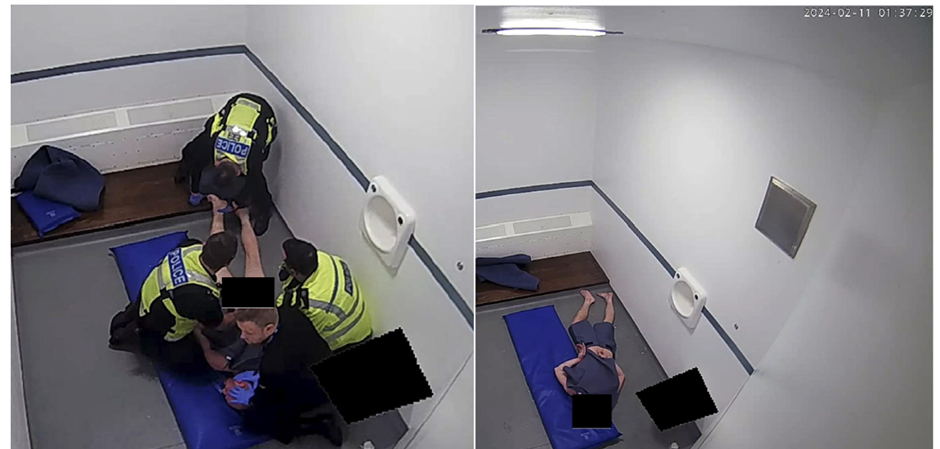
Last year, footage showing five officers assaulting a detainee (‘D’) found its way onto social media, receiving over 800k views. They struck and kicked D, then forcefully stripped him while he was pinned to the floor (he passed out as a result). Next, officers abandoned D—leaving him prostrate, unconscious, and unsupervised on the cold floor (more details of D’s ordeal here).
Not long after, (ex) Guernsey’s police chief exonerated his employees, blamed D for the events, and declared that police had followed protocol. Speaking to ITV in June 2024, Chief Officer Ruari Hardy justified officers’ conduct by claiming D had ‘threatened to self-harm’. Worse, by framing D as the bad guy and even guiltier than the accused officers, Hardy put forward a self-serving narrative, drawing the spotlight away from his employees’ wrongful acts.
Based on Hardy’s interviews, it is unlikely that people would think officers were in the wrong. Fortunately for the truth, and unluckily for the Chief Officer, events were captured and posted online for the world to see. This shows all the things Hardy’s interview carefully omitted: namely, that the Chief Officer had lied to mask what had really happened.
According to D, Hardy didn’t just lie by fabricating a story about ‘self-harm,’ but he also omitted crucial information, misrepresenting events. It was an attempt to dupe the public, and it might have worked if not for the extensive video evidence already in D’s hands. Evidence showing Hardy’s claims—officers assaulted, pinned, and stripped D because of ‘threats to self-harm’ and a ‘ligature risk’—to be false. Instead, footage shows PC Winberg asking D for his clothes “because of the PAVA,” an incapacitant spray officers had employed earlier. Winberg is again seen asking D for his socks, shoes, and shirt, “obviously because of the PAVA.”
Hardy’s defence also included an accusation that the footage had been edited, a claim that was partially accurate—in efforts to upload the footage onto social media, not all of it made it. However, Hardy then went further, alleging footage had been ‘spun’ with a view to mislead the public.
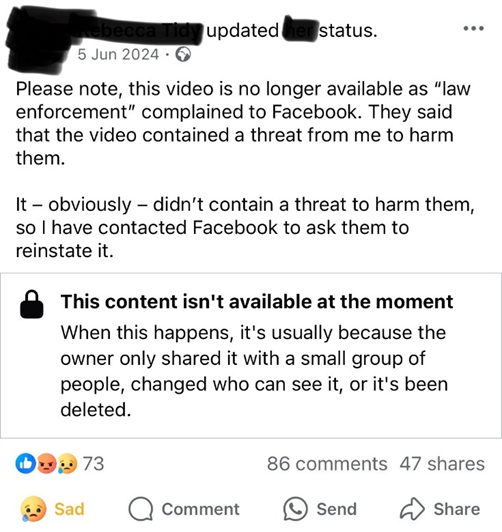
To prove this wasn’t the case, D shared the entirety of the footage (via a journalist). Yet no sooner had it gone public, Guernsey police falsely stated that the footage contained “a threat from [the journalist] to harm [officers].” Facebook removed the video. So I decided to upload the same to see what would happen. Police again complained, and the video was again quickly removed.
Later, Hardy tried to bolster his credibility by claiming, “In nearly 40 years of public service, I have never been subject to allegations such as these.” Yet this doesn’t appear to be accurate, as allegations against him in one instance resulted in an investigation (into him) by Kent police over charges of “corruption, negligence, and unethical conduct” (related article here).
Moreover, a complainant went public to confirm she had in the past accused Hardy of similar charges:

In June 2024, D and his family filed a complaint with the Committee for Home Affairs and threatened Hardy with a defamation lawsuit. After hearing nothing back from either party, not even an acknowledgment letter, the family followed up with a chaser in September—which Home Affairs ignored.
Meanwhile, and unbeknown to D and his family, A. Whistleblower provided Guernsey politicians (‘Deputies’) with copies of their complaint and chaser, and then leaked them on X.
To date, neither Home Affairs nor Ruari Hardy have replied. In efforts to seek acknowledgment of their concerns, D and his family, alongside but unrelated to A. Whistleblower, turned to Deputies and the Commissioner for Standards for help.
Three months following the submission of a Conduct Complaint against the President of Home Affairs, Deputy Prow, the Commissioner—mirroring Home—has not responded. Deputies, too, have declined to help; demonstrating a disinterest in voters’ concerns and an absolute refusal to challenge colleagues’ increasingly improper behaviour.
Guernsey’s notable lack of accountability and transparency for authority figures means lying and deceiving isn’t just the norm—it’s expected. Such behaviour in politics and policing is well documented. Deliberately ignoring this has become a routine part of both worlds (case in point). Whether it’s police leadership ignoring subordinates’ misdemeanours; Home Affairs overlooking senior officers’ ethical breaches; the Commissioner of Standards disregarding the same for Deputies; or Deputies widespread apathy towards anything that isn’t in their own interests. Members of the public hoping to raise valid concerns quickly find that complaining in Guernsey gets your nowhere.
For all the twists and turns of this case, two things stand out: the head of law enforcement lied publicly; and the Committee for Home Affairs turned a blind eye. This story is a telling example of how police officers use their influence to mislead and cover things up, with complicity from the Committee tasked to oversee them.
Let this serve both as a warning and as a call to action. If we have any hope of stopping this type of bad behaviour we need to act, and soon. With a general election fast approaching, now is the time to vote in leaders willing to implement accountability measures to increase transparency across the board. Leaders who haven’t forgotten that telling the truth is a necessity: not a choice.