

EX-CHIEF OFFICER RUARI HARDY AND DEPUTY ROB PROW
Last Saturday, local media outlets—perhaps unwittingly—launched what amounted to a free PR campaign for former Chief Officer Ruari Hardy. Headlines praised his “honesty and integrity” following an investigation that supposedly cleared him of wrongdoing. Yet the Committee for Home Affairs, led by President Rob Prow, misled journalists by conflating the case in question with an unrelated firearms appeal resolved in August 2022. The actual complaint, lodged in December 2023, accused Hardy of perjury in entirely separate proceedings in 2023. Here’s how it unfolded—and why the truth remains elusive.
It all started on 12 December 2023, when my co-complainant and I wrote to Home Affairs alleging that Ruari Hardy had lied in Royal Court proceedings 2427/2428, which concluded in February 2024. The complaint focussed on Hardy’s sworn statement of truth (‘affidavit’) signed on 9 August 2023 (below). Lying under oath is a criminal offence (perjury), and involves two conditions: a false statement and an intent to deceive. It can also be established if a judge believes the affidavit was submitted with ‘reckless disregard for the truth’ (also included in the complaint).
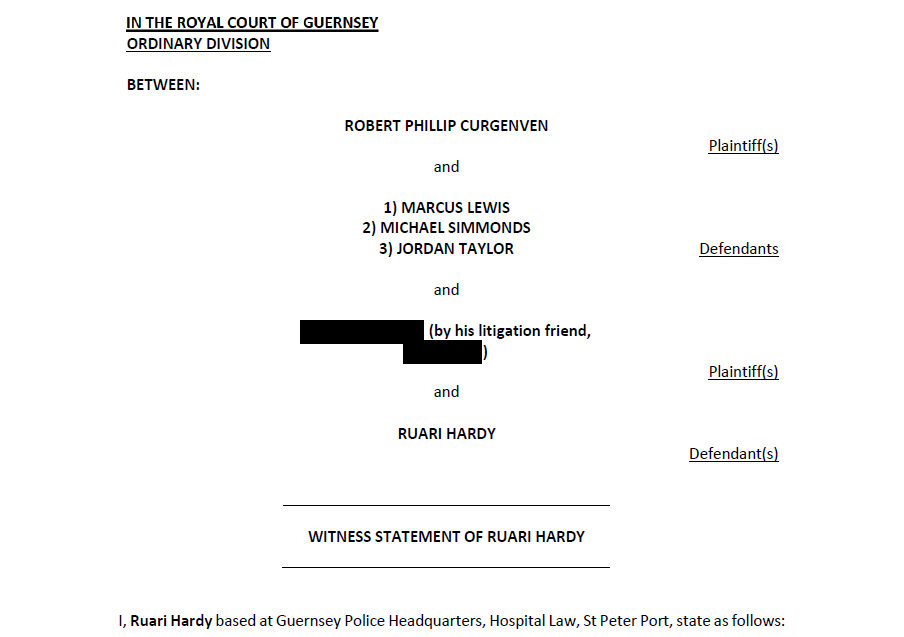
RUARI HARDY’S AFFIDAVIT, 9 AUGUST 2023
Six months later, Home Affairs finally responded. The Committee said that committing a serious criminal offence “may not align with the role of Chief Officer” but “there is no reason to suspend [Hardy] from service.”
Another 3 months go by, again with no updates, and in October 2024 West Midlands police (‘WMP’) contact us. They’d only just been informed of the complaint—ten months after it had been filed—and planned to visit the island to investigate. But something felt off. I’d dealt with Hardy and Prow long enough to grow wary of their tactics.
Suspicious, I requested the Terms of Reference (‘ToR’) Home Affairs had given WMP: a document setting out the details of the investigation into Hardy. They passed on my request to Home Affairs, who refused to share it (Prow falsely claimed the ToR was covered by legal privilege). WMP did reveal, however, that the Committee had directed them to examine Hardy’s affidavit from my firearms appeal, dated 22 June 2022—not the affidavit signed on 9 August 2023. I wrote back, correcting the ‘error’, attaching another copy of Hardy’s affidavit from 2023.
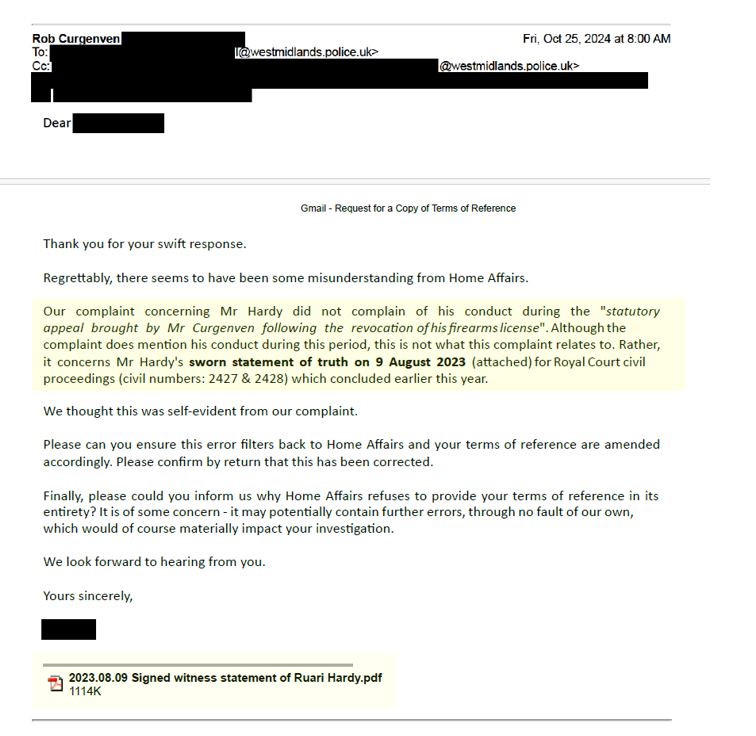
EMAIL TO WEST MIDLANDS POLICE, 25 OCTOBER 2024
Growing more and more nervous Prow would intentionally mix the firearms appeal with proceedings 2427/8, I tried to nip it in the bud. I wanted evidence, a paper trail. So I wrote to Home Affairs at the end of October, on now a third occasion, again clarifying the nature of the complaint:
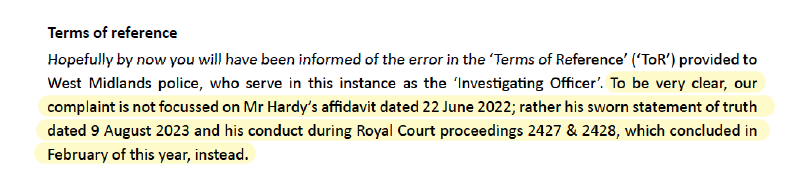
EXTRACT: LETTER TO THE COMMITTEE FOR HOME AFFAIRS, 30 OCTOBER 2024
When we met face to face with WMP, officers seemed somewhat taken aback by the misinformation they had received. They assured us they’d investigate the correct affidavit—now the fourth confirmation we’d provided. Nothing but silence followed. Then, on 19 March 2025, 16 months after the submission of the criminal complaint, nearly 5 months following Hardy’s resignation, Prow emailed to say Hardy was cleared of all charges.
Last Friday, I received a cryptic email from the Bailiwick Express about an article set for publication the next day, leaving me no option to comment. When I woke the following morning I was, to say the least, stunned. Hardy’s face was plastered across various front pages, with journalists claiming he did not lie in a court hearing*—relating the firearms appeal in 2022.
Of course, this wasn’t a slip; Prow had done this deliberately. And Hardy had been in on it, too. After all, he knew the complaint centred on his admissions during proceedings entirely unrelated to the firearms appeal, but nevertheless mislead readers into thinking the opposite was true. Both conflated two entirely separate proceedings to confuse readers, discredit me, and draw people away from the facts. Prow’s tried and tested tactic. Gavin St Pier was one Deputy who saw through it last year:
“The claim that one of the litigants [Rob Curgenven] had been lawfully arrested is unfounded. Taken with the link being made to the quite separate firearm’s appeal, it appears, unfortunately, to be an attempt to discredit the litigants.”
Prow even attempted to conflate Moneyval’s impending inspection with the firearms case to shut down parliamentary questions over police misconduct. Once again, this was picked up by St Pier: “Attempting to conflate the two provides no grounds for limiting scrutiny.”
Public observers, like Mr. and Mrs. Langmead, echoed this in a letter to Deputies last year: “The Committee for Home Affairs tends to conflate entirely separate issues.” As far back as January 2023 Prow had been desperately trying to bury Hardy’s and his officers’ misconduct with a secret deal. Prow wrote that he wanted to stop my wife and I making “any further noise.” And, in relation to the police complaints still in the system, informed fellow Home Members, “there is still much work to do.”
So I nearly choked when I read the follow-up articles. Hardy, again given pages of free PR, seized the red herring laid down by Prow—the firearms case—and used it to trick readers into thinking “his ‘honesty and integrity’ has been upheld.” His only truthful remark? “The outcome of this investigation is not a surprise to me.” Given the apparent orchestration with Prow, it’s hard to argue otherwise.
This isn’t an isolated incident, either. Home Affairs has never held a senior officer accountable, despite Hardy facing four complaints alleging similar misconduct. Prow’s pattern—vague responses, withheld reports, and selective framing—shields the system but at the expense of transparency. Taxpayers foot the bill for investigations, like WMP’s, yet the findings stay locked away; further undermining public trust in both Guernsey police and Home Affairs. Hardy, meanwhile, retains his State pension and reportedly transitioned to teaching at a local College. Worse still, I’ve heard rumours that Hardy intends to stand in the upcoming election.
Yet the media bears some responsibility, too. Outlets like the Bailiwick Express ran Prow’s version without any verification or seeking our perspective. A simple cross-check—or quick email to me or my co-complainant—could have exposed the disconnect. Instead, they handed Hardy a victory lap, potentially exposing themselves to legal risk if misreporting proves actionable.
In February 2024, I predicted this outcome: Prow would clear Hardy with a vague statement, cherry-pick WMP’s findings, and bury the full report. Home Affairs’ communications team would spin a favourable tale for local media, who’d publish it uncritically and without thinking. And that’s precisely what happened. But at what cost? I don’t feel vindicated, rather I’m sad. Despite most people, including those in power, seeing through the deception, no one really seems to care. These events will simply fade away in the annals of the past, another erosion of justice and accountability, at the expense of the taxpayer. Local media are unlikely to care and even less likely to learn; they’ll continue to comply in disseminating narratives provided by agents of the State, without bothering to check whether it’s true or reporting on any other side of the story apart from what they’ve been given.
* Some readers noted that Prow and Hardy were very careful with their wording. Though WMP police allegedly found that Hardy did not lie, he still provided the Royal Court with false information. He was, again allegedly, cleared of perjury because an intent to deceive also needs to be proven. Yet people who have viewed the complaint all agree—Hardy knew, or certainly should have known, given his position as Head of Law Enforcemenet and the Data Controller for Guernsey police, that the information he gave to the court was false.
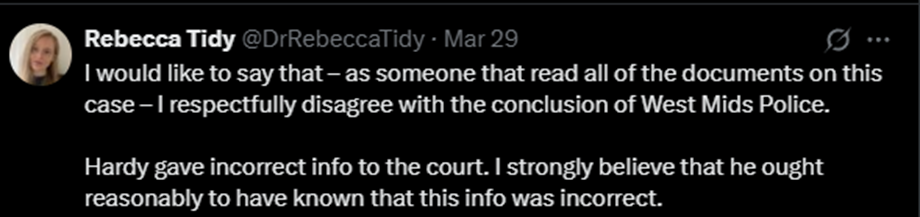
DR REBECCA TIDY TWEET, 29 MARCH 2025