

Speculation over an “active paedophile ring” in Guernsey has gripped the island, fuelled by a mysterious electronic list naming seven locals. What began as whispers has spiralled into a tangle of police denials, lawsuits, and lingering questions. Is there a sinister network at play, or just a provocative hoax? Here’s what we know—and what we don’t.
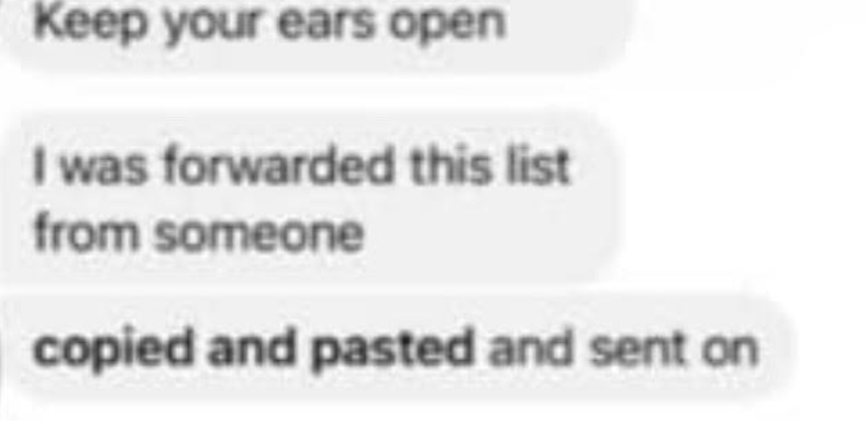
Surfacing early Autumn last year, the list was rumoured to be a paedophile’s “suicide note”, naming his supposed accomplices. While some reports suggest there were eight names, the list actually only included seven. One entry simply read “another [profession]” with no further details. Beneath the names, the messages went on to say:
Guernsey Police’s statement on 19 November 2024, aimed to address the growing frenzy sparked by the list, asserted that none of the named individuals were currently under investigation. They did, however, acknowledge that two of the named individuals—later identified as Liam McILroy and Darrin Bellingham—had been previously investigated and charged with sexual offences against children, with their cases already in the courts and publicised by the media. Police clarified the cases were unrelated, and a prison officer’s court appearance that day (Jason Tardif) was purely coincidental.
The list itself is riddled with inconsistencies. For example, one of the names used a professional title that hadn’t been used in nearly a decade, and another individual had been deceased for years. Two others appeared to have no connection to any of the events in question. This leaves three entries: “a prison officer”, Liam McILroy, and Darrin Bellingham. The list’s credibility, therefore, hinges on three known but unrelated court cases, with underlying events unfolding across mid-2024:
- 21 June 2024: A man is hospitalised after driving his car off Jerbourg cliffs. Though the driver’s identity remains unknown, sources say the driver was Liam McILroy, who allegedly attempted suicide while intoxicated.
- 28/29 June 2024: Jason Tardif, head of security at Les Nicolles Prison, is arrested following his “indecent behaviour” (towards an adult) during a massage.
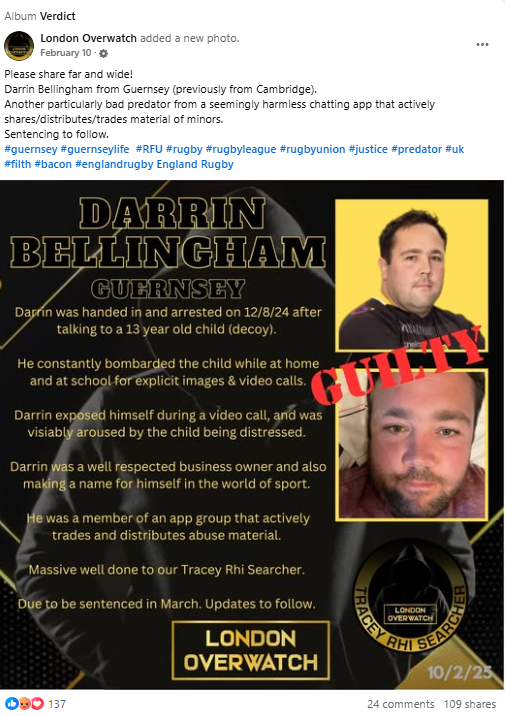
- 12 August 2024: According to London Overwatch, a paedophile hunter group, Darrin Bellingham was arrested after attempting to communicate with someone he thought was a 13-year-old girl.
- On 7 October 2024: Police search McILroy’s home and seize devices containing 16 images of children, sent via the chat app Kik. While details are scarce, it’s speculated that McILroy’s car crash drew police attention, leading to the search. This fits with McILroy’s subsequent admission of attempting to take his own life.
The list came from McILroy, we were told, who reportedly named his accomplices when attempting suicide. This narrative links McILroy to Tardif and Bellingham, suggesting a network. But this connection doesn’t hold up under scrutiny. These incidents, though serious, show no apparent links.
For one, Guernsey police were oblivious to Bellingham’s activities until he was caught in a sting operation run by London Overwatch. There appears to be no link between Bellingham and McILroy. Tardif, meanwhile, was arrested months earlier for unrelated offences. His case had nothing to do with either McILroy or Bellingham. When police made their statement on 19 November, Tardif had entered a “not guilty” plea in the Magistrate’s court. The timing was unfortunate, but it was a mere coincidence.
The police statement raises eyebrows, though. It claimed the cases of McILroy and Bellingham had “already been publicised by the media” prior to 19 November, yet I found no such articles prior to that date—or even until 2025*. This is puzzling. If no public media coverage existed, how could the list’s author (‘Author X’) have known about McILroy and Bellingham; unless they had insider knowledge? Or had Author X smartly woven together a fabricated list based on unrelated rumours?
To get to the bottom of this, I today filed a Freedom of Information (FOI) request, asking police to identify the media publication or publications referenced in their statement. I also ask when the Royal Court write ups for Bellingham and McILroy will be released. These reports usually prompt media coverage, but at the time of writing they are nowhere to be seen. Did journalists have access to these write ups before publishing associated articles? Why are the write ups not yet public?
Additionally, Tardif’s sentencing was delayed, as he “is bailed to appear in court towards the end of April in connection to another matter.” Details of this remain unclear, and while some claim to know more, none have stepped forward and provided specifics.
So, does Guernsey have itself a paedophile ring? The available evidence leans away from such a conclusion. Three arrests in a small community like Guernsey might spark rumours, but correlation isn’t necessarily causation. Tardif’s case doesn’t fit the pattern, Bellingham’s came via London Overwatch—not police linking him to McILroy—and McILroy’s actions lack accomplices (at least on the record). The list blends fact with fiction, a hallmark of effective deception. Author X—perhaps a local with scraps of gossip—remains a shadow figure. That’s not to entirely discount the possibility of a paedophile ring or rings, however, only that this specific list doesn’t identify one.
Police insistence on prior media coverage, absent from any searchable record*, invites scepticism but isn’t proof of a cover-up. The articles could have been published in the paper edition only. The FOI response should clarify whether Author X simply read about McILroy and Bellingham, dissolving the enigma. Without that, their inclusion feels more like a fluke than a revelation.
Ultimately, this list appears more like a provocative hoax than evidence of a paedophile ring. A personal attack even. While police statements raise legitimate concerns, the lack of corroborative evidence and the presence of inconsistencies suggest that the story has been exaggerated or even fabricated. We must remain vigilant but sceptical—rumours and speculation can do more harm than good, especially in a case this sensitive.
* I visited the Priaulx Library to search through Guernsey Press’s archive of printed papers; but found no mention of Bellingham or McIlroy prior to the Guernsey police’s statement made on 19 November 2024. So where are these publications that police say exist in this period?