
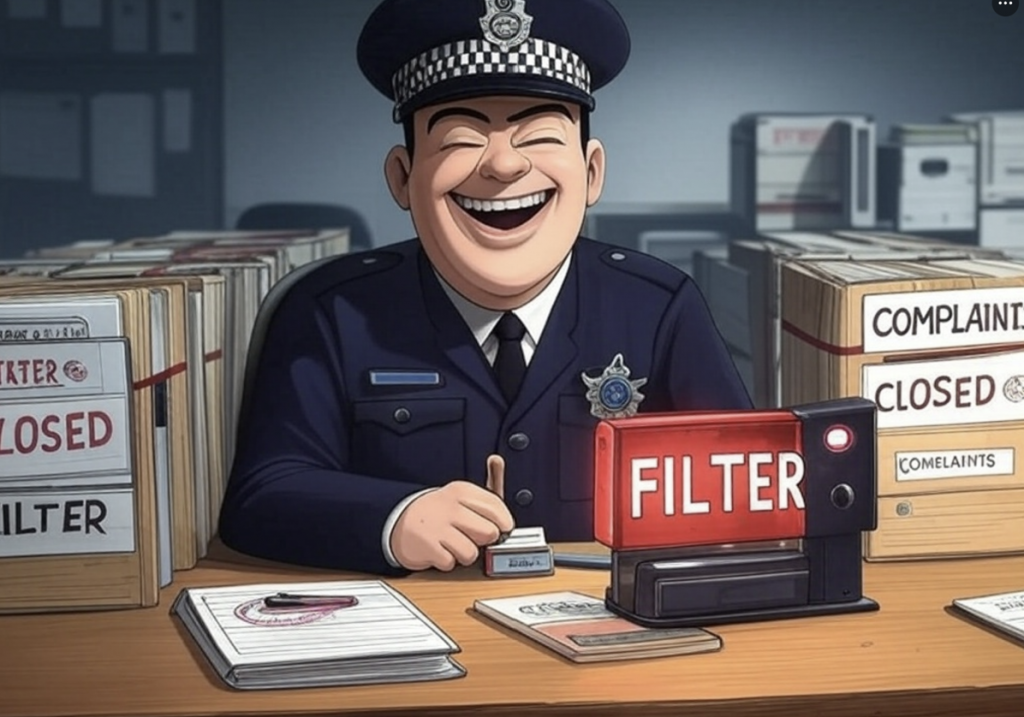
A few years ago, Guernsey police got busted “filtering” complaints—an unlawful tactic they swore to end. Despite these promises, the practice continued. Here’s proof they’ve been lying to you all along.
In early 2023, the Isle of Man Constabulary (‘IoMC’) visited Guernsey to conduct on-island inquiries into local police officers. The cases involved various allegations concerning three constables and a sergeant, and including criminal accusations. Among other charges: lying to a suspect in a recorded interview, fabricating evidence, and perverting the course of justice.
While carrying out their duties, the IoMC chanced upon something unexpected: Guernsey police was “routinely” filtering complaints—dismissing them without formal investigation—in clear violation of the law.
“This procedural error,” said the IoMC, “effectively closed the complaint without a further formal investigation under disciplinary notice”. This alleged error allowed law enforcement bosses to bypass the complaints process, circumventing formal inquiries—particularly those into criminal complaints—without anyone being the wiser.
As the IoMC’s investigation progressed, Guernsey PC Aaron Cusack was found to have unlawfully pressured a victim into withdrawing her rape complaint. Notably, PC Cusack admitted to similar if not identical issues raised by countless complainants; issues found also within the complaints being looked into by the IoMC.
Deputy Chief Officer Philip Breban quickly responded by denying Cusack’s claims, despite these claims being corroborated by both IoMC officers and the majority of complainants.
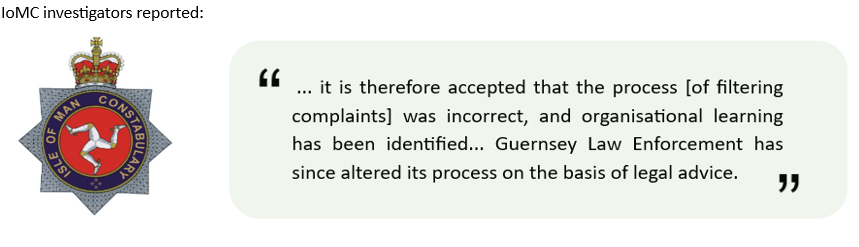
However, this turned out to be a lie. Not only did police command refuse to stop filtering complaints, they continued to filter complaints alleging criminal conduct. This ensured that officers would face prosecution only in the most public of circumstances, like PC Cusack, effectively providing them partial immunity from criminal charges being brought against them.
Can this be proved? Yes, it can. Reviewing complaints filed between 1 April 2023 and 15 August 2024 reveals that the illegitimate filtering of complaints persisted, despite claims to the contrary.
Case studies
On 11 February 2024, Ms. A reported being unlawfully assaulted and hospitalised by PC Winberg, who left her unconscious and with lasting injuries. Nearly a year after claiming to have stopped filtering complaints, Deputy Chief Officer Ian Sholes did exactly that—he filtered Ms. A’s complaint, halting formal investigative work in the process.
Yet this didn’t stop DCO Sholes’s counterpart, DCO Breban, from misleading the public into believing a formal investigation into Ms. A’s complaint had been carried out. As a result, DCO Breban claimed, PC Winberg was exonerated. However, both statements are far from true. DCO Sholes’s letter and a recorded conversation with DS Telford quickly confirm the lie (extract below).

On 9 April 2024, Mr. B filed a criminal complaint against PC Potter, who was caught on camera riding in excess of double the speed limit, overtaking cars, riding on the wrong side of the road, and nearly taking out pedestrians in a mad dash up Fountain Street. Nearly four months later—during which time the complainant received no updates—DCO Sholes finally responded. As expected, Mr. B’s complaint was improperly handled, halting a formal investigation before it could begin.
A lack of oversight
You may be wondering: if the illegitimate use of a filter was indeed the norm, why had no one discovered it sooner? Simple: Unlike most of the forces in developed countries, Guernsey police operates without oversight. The Chief Officer is lawfully responsible for the outcome of all complaints, appeals, and disciplinary panels—everything’s in house.
No independent or impartial ombudsmen protects members of the public; no one to check in on what officers are doing, or how they’re doing it. Remarkably similar, in fact, to William Golding’s Lord of the Flies. A story about a group of boys (police officers) who are stranded on an uninhabited island (in this case, inhabited), and their disastrous attempts to govern themselves.
To make matters worse, the Committee overseeing law enforcement has been labelled so dysfunctional that calls for an independent review were made amid “serious concerns about [Home Affairs] governance”.
The resultant review concluded the Committee’s “governance falls below acceptable standards”.
Author of the review, Catherine Staite, found that Home Affairs “had provided no strategic leadership to Law Enforcement, as a result of which the police developed their own policing plan…”.
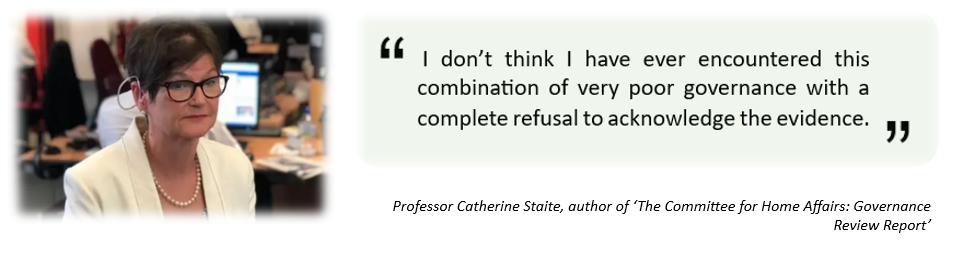
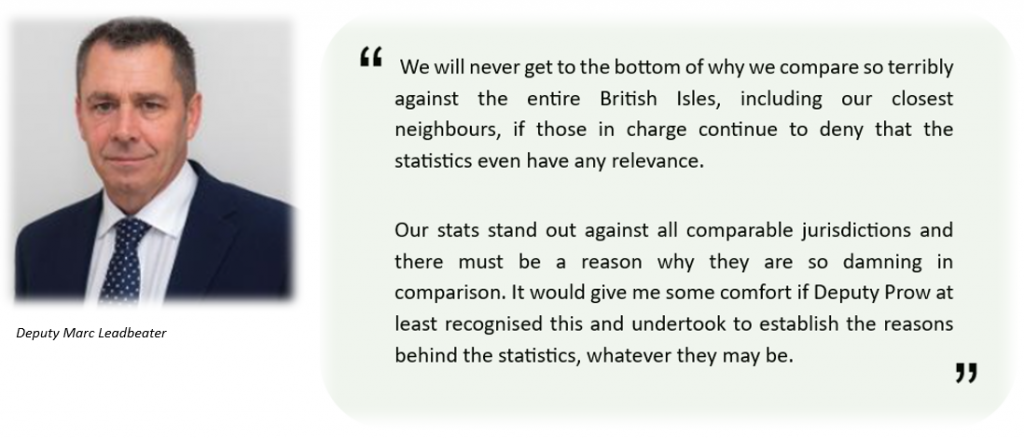
As any local will tell you, Home Affairs is guilty as charged for refusing to acknowledge evidence, but none more so than its President, Deputy Robert Prow, who gained notoriety for his catchphrase “We Have An Excellent Police Service”, in direct opposition to all available evidence. Deputy Marc Leadbeater criticised Deputy Prow’s head-in-the-sand attitude during a States Assembly in early 2024:
Time for honesty
These damning findings lead members of the public to question not just the behaviour of a ‘few bad apples’, but whether a system by which the Guernsey police police themselves needs urgent, radical reform.
If (new) Chief Officer Damian Kitchen is serious about rebuilding trust, the first step is being open and honest. This includes acknowledging past mistakes, owning up to misleading statements, and ending the use of evasive language to avoid giving direct answers.
If Guernsey police officers can’t be honest—especially when confronted with proof of their own dishonesty—how are we supposed to trust them?