
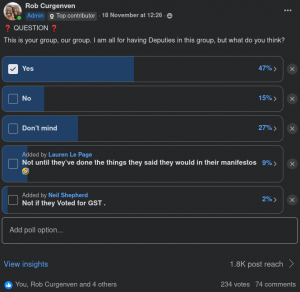
The question of whether Deputies should be allowed into our “The Public’s Trust Guernsey” Facebook group has sparked a lively debate among our members. Here’s how it split:
- 47% are in favour of allowing Deputies to join.
- 15% are against their inclusion.
- 27% don’t mind either way.
- 9% support their inclusion only if Deputies fulfil their manifesto promises.
- 2% oppose their inclusion if they voted for the Goods and Services Tax (GST).
The comments accompanying the poll provide insight into the diverse opinions held by group members.
Another member suggested giving Deputies the benefit of the doubt, emphasizing the group’s commitment to honesty and transparency. They expressed hope that Deputies would engage constructively and be held accountable by the community.
Skepticism and Distrust
On the other side of the debate, some members are sceptical about Deputies’ willingness to listen and act on the community’s concerns. Past experiences of being ignored or blocked by Deputies on social media have left some feeling disillusioned. One commenter shared, “For me personally, they don’t listen… After emailing many Deputies.. they just block you.”
Others fear that Deputies might use the group merely as a platform for political gain without genuine engagement. Concerns were raised about them saying what they think people want to hear, only to act differently later. “They only say what they think we want to hear… If they join.. they’ll just be after brownie points,” a member cautioned.
Conditional Acceptance
A notable portion of the community is open to Deputies joining but with conditions. Some want to see Deputies fulfil their manifesto promises first, while others are adamant that those who voted for GST should not be allowed in. There’s a sentiment that Deputies need to prove their commitment to the public before being granted access.
The Case for Open Dialogue
Despite the mixed feelings, the overarching theme is a desire for open dialogue and accountability. Allowing Deputies into the group could bridge the gap between the electorate and their representatives. As one member aptly put it, “Yes, our staff should know what their employers are whinging about… They work for us.. our taxes pay their wages.”
Another member highlighted the importance of embracing freedom of speech and not discriminating against any individuals unless they break group rules. “That way, we have a balanced view,” they added.
Conclusion
Based on the group’s consensus, we will allow them in. But the very question being asked at all doesn’t say much about public trust in those who represent us.