

Everyone agrees that lying is wrong, but pinning down what counts as a lie has kept linguists, philosophers, and lawyers busy for centuries. For this article, a “lie” requires two conditions: a false statement and an intent to deceive. Incompetence, on the other hand, is when someone lacks the skill to get it right. So, when Guernsey’s President of Home Affairs, Rob Prow, was found to have made false statements, we were left asking: was he lying, or just inept?
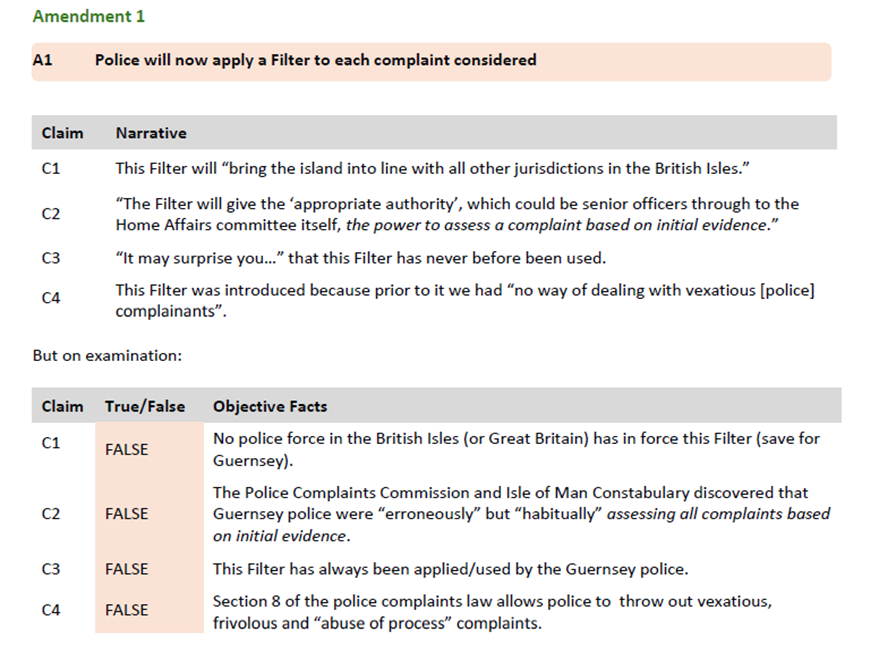
In late 2024, while introducing amendments to laws governing police complaints, Deputy Rob Prow went to great efforts to justify the need for these changes. And, in doing so, he made a number of false statements. An extract taken from a letter to States Members shows a small selection (below, C1-4). With the first condition of a lie being met, more than once, we are left with the second: did Prow know his statements were false at the time?
Prior to Prow’s rise to Home Affairs in 2016, he spent 40 years working in law enforcement, climbing from frontline officer to Head of Customs (GBA), where he served for eight years. Save for his abrupt resignation following the damning findings in the ‘Staite Report’, Prow has spent 11 years on the Committee overseeing law enforcement (four years as President). Could he really have been unaware that his statements were untrue?
Of course, the only person who can speak to his intent at the time is him. And he, nor anyone else, would likely admit to lying. Let’s assume, for the moment, that Deputy Prow was sincere when he made his statements. Now he has discovered evidence that his statements are not true. Yet he has failed to correct them. It may not have been a case of lying or deception at the time he made his statements, but now that he knowingly lets his past false statements stand, it is tantamount to deception. Ignorance might excuse the first few slips; silence after the fact looks deliberate.
For readers who have given Prow the benefit of the doubt, and going forward on the basis that he had no intent to deceive, does his conduct not satisfy the definition of “incompetent”, instead? First, the President of Home Affairs has shown a rather worrying lack of knowledge over existing laws—those he worked under for four decades, as well as those he was instrumental in introducing. Second, he has many times failed to verify information that was fundamental in rationalising his legislative changes, before presenting them to States Members, the media, and the public.
This article was, in part, prompted by Deputy de Sausmarez’s recent behaviour. Responding to criticism that she perhaps hadn’t been entirely transparent, or in any event had confused people, over recent housing legislation, de Sausmarez took to social media to confront this feedback head-on. The content of her replies is not important, but rather the fact that she did reply when challenged. In contrast, Deputy Prow has refused to correct or even respond to proof that his statements were false.
With a general election fast approaching, voters must give careful consideration to potential leaders: will they operate in an open, transparent and honest manner? With Deputy Prow eyeing up his new role as Chief Minister, never before has voting been so crucial for Guernsey’s future.