

“An Englishman’s home is his castle,” goes the old-fashioned idiom. Apparently attributed to the English judge Sir Edward Coke, who declared it in 1604 in a common law ruling establishing strict limits on how sheriffs could enter homes. Yet a swathe of new laws coming from Guernsey’s Home Affairs means the right of your home being your castle has finally come to an end.
If you’re arrested, police have 24 hours before they must release you. But gathering evidence can take weeks, months, or in the case of Guernsey police, years. A lot of the time officers won’t have enough to charge suspects, so they have to let them go. Home Affairs wants to change this by endowing police with powers to be able to subject suspects to “pre-charge bail” (‘PCB’). Not just in relation to domestic abuse and sexual offences, but rather across the board.
This means suspects can be released from custody, but they must comply with certain conditions. The catch being the conditions are set by the Guernsey police. Remember: at this stage you are innocent. You have not been charged with a crime. Yet the person behind the custody desk has the power to impose any form of restriction(s) on you as they see fit.
Such as being kicked out of your home, banned from drinking, subject to a curfew, limitations on where you go and who you interact with, a combination of these, you name it. Mainland police have a limited number of processes to stop them abusing these powers. But from what I understand of Home’s legislation it has no such safeguards, meaning you could be left in limbo for months or even years still having to abide by the conditions set by police (this has happened before).
And it gets worse. Home Affairs has invested police with the power to enter your home to search for anyone subject to PCB conditions—without a warrant. Officers can turn up, unannounced, at any time of the day or night to perform whatever checks they feel prudent.
To give you a real life example of how this looks: officers visited X where he lives with his family at 11pm, another day at 2am, and so on. Threatening to kick the door in and demanding to see X on each occasion. Causing such a racket the whole family woke up, terrified, thinking a gang was breaking in.
However it is framed, PCB is an infringement on the liberty of someone who has not been charged with a crime. It is punitive, bureaucratic and stigmatising. It’s also unenforceable, since breach of PCB is not a criminal offence. In other words, you can be arrested for breach of PCB condition but you can’t be charged for the breach.
Home Affairs sold PCB by claiming it filled “identified gaps in existing legislation and processes”. However, the Committee declines to identify exactly what these gaps are and precisely how this new legislation fills them. Thus, I was forced to turn to English guidance to discover the two main justifications for PCB: to “keep tabs on” suspects and to protect alleged victims.
Yet when dealing with victims the guidance ties itself in knots, partly because it is not evidence based. The guidance says that victims should be “consulted” about PCB conditions, even before officers have established that a crime was committed.
The guidance also claims victims think they are safer if PCB conditions are used, but this is based on small scale qualitative research. Victims who think they will be safer are presumably responding to what they have been told (by police). Meanwhile, there is no evidence to suggest PCB protects victims nor what effect different impositions will have. Are victims to be told that PCB conditions are not enforceable? If they are I doubt they would be persuaded of their worth.
The guidance does admit that there is no evidence PCB impacts on offending, but also says that police should take positive action when conditions are breached to ensure “that the suspect is aware that further offending behaviour will not go unaddressed”.
“Further offending behaviour” implies that the suspect is guilty of the offence for which they were initially arrested; and that they have committed an offence by breaching PCB bail. Yet neither implication is correct. And the threat of “consequence to a breach of bail conditions” is empty since there is no real consequence. Nor should there be, given the suspect has not actually been charged with a crime, and may never be.
Across the pond there are serious concerns over PCB, where it has not been subject to parliamentary scrutiny. Home Affairs has compounded these problems by, in accord with its modus operandi, cherry-picking bits of other jurisdictions’ legislation with a view to bolstering police powers; whilst being especially careful to weed out the checks and balances necessary to counter any abuse of this power.
The vigilant selection of certain parts of laws from elsewhere, and the equally vigilant removal of certain parts of the same, are woven tightly together. The finished product ends up as Deputy Prow’s ubiquitous sales pitch: “this [insert mangled legislation here] brings us in line with other jurisdictions”.
But Home Affairs didn’t roll out the Domestic Abuse and Related Provisions (Bailiwick of Guernsey) Law, 2024 (‘DARP’) purely because it cares about victims of crime. It did it to protect the police’s reputation, and by extension, its own. To explain, we have to go back to a damning police email from June 2023. In short, police openly admitted they lacked the training needed to deal with domestic abuse.
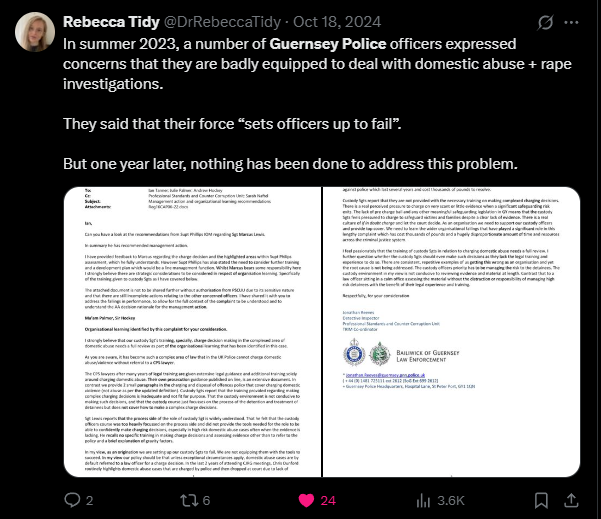
Despite this, Home Affairs made no efforts to sort the problems. That abruptly changed when, in October 2024, the email headlined on ITV 6pm news. Suddenly, Home Affairs rolled out DARP, claiming that it “takes domestic abuse and related offences very seriously”. On the face of it, then, DARP is simply another firefighting exercise in efforts to quash the damage done by the flames of police incompetence made public.
Furthermore, Deputies Prow and Aldwell are quick to take credit for DARP. Both seem to have wandered off from the hard path of reality and into the Land of Wishful Thinking: the sweat and elbow grease that got DARP off the ground came from the likes of ex- Deputy Mary Lowe and Deputy Leadbeater.
Two tenets of law are thus: those accused of crime should be free until they are found guilty; and everyone’s home is their castle. However, Home Affairs almost pathological obsession with needlessly increasing the already considerable powers of police erode these rights. Greatly restricting the liberty of innocent people, while simultaneously giving victims the wrong impression of being protected.
Let us hope that, this time, Deputies will finally challenge Home’s changes. Or at a minimum, ask for more time, so they can get to grips with the legislation they would otherwise so carelessly permit.