

In Guernsey’s close-knit community, the trust survivors of violent crime place in me is both humbling and heavy. Women and families share their stories of pain and betrayal, often unreported by local media, revealing a troubling truth: our laws are not the problem—it’s the training of those tasked with upholding them that fails victims.
Ms. A, a survivor of domestic abuse, spoke with mixed emotions after reading about recent legal changes supposedly meant to protect people like her. “Let down. Happy. Angry,” she said. Her ordeal with Guernsey police had turned into nothing short of a nightmare. Police had advised her to pretend to be in a (sexual) relationship with her abuser, promising his arrest the next day. Yet a week passed before they acted, placing her in very real and very obvious danger. “Completely unacceptable,” her lawyer had written, a view echoed by SAFER, a local victim support group.
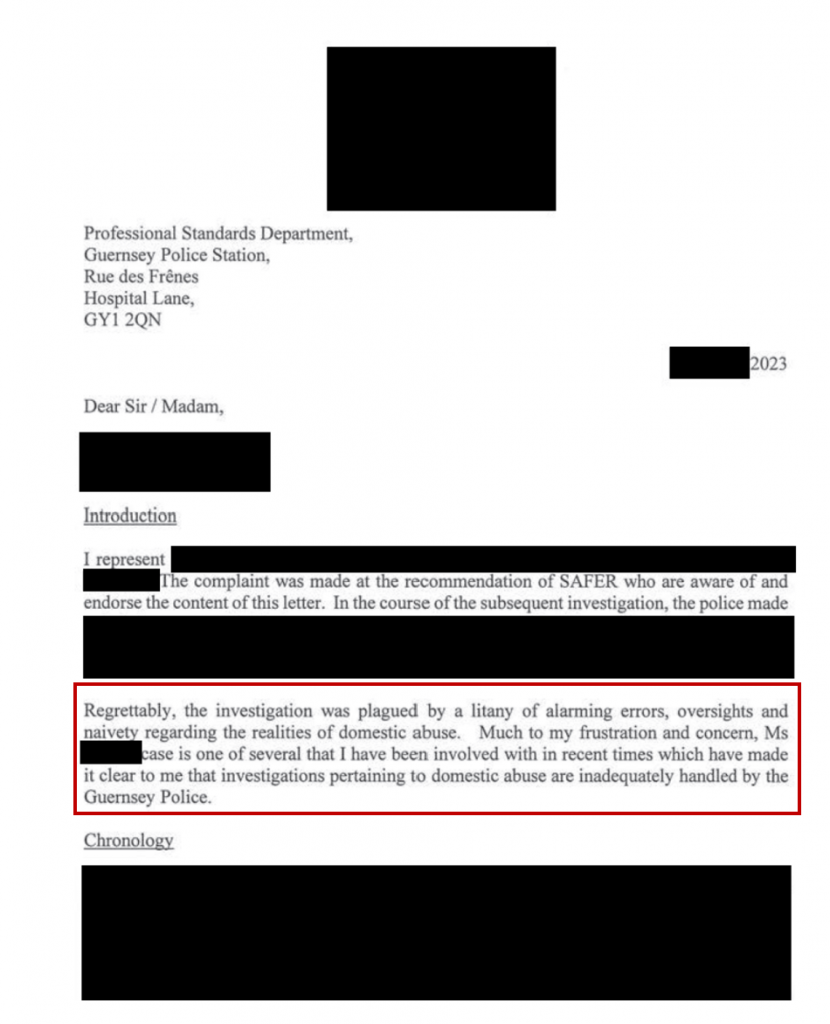
MS. A’S POLICE COMPLAINT (WRITTEN & SUBMITTED BY HER LAWYER)
Another time, a male officer had visited Ms. A’s abuser. “We know you’re not the problem,” the PC told him, on camera. “She is.”
Ms. B faced similar dismissal. After surviving a rape, she handed over text messages where her attacker essentially admitted the crime. Police responded by telling her the violent sexual assault was “probably a mistake.” Officers later claimed “it’s not rape because you didn’t say no,” revealing a worrying misunderstanding of consent. Ms. B recently contacted the Chief Officer, via a politician, explaining her concerns; but he dismissed them in a short email, not even bothering to look.
Ms. C, a 14-year-old sexual assault victim, reported her ordeal only to hear police dismiss it as “violent horseplay.” She’d been forced into Beau Sejour toilets for unprotected sex; had received beatings and abuse and humiliation; been dragged to and fro, by her hair, by her laughing abuser. When police drafted witness statements they were so riddled with errors that she and her friends refused to sign them.
Another sexual assault survivor recently went public, after her TikTok video describing how Guernsey police mishandling had traumatised her garnered over a million views. She, along with other female victims, wrote to politicians last year. Nothing came of it. A few female politicians appeared interested, at first, yet their interest quickly waned. One did say, “I’ve chased Deputy Prow [head of Home Affairs] twice with no success. I will keep on at him though and get you some answers.” She didn’t, though, either keep at it or get any answers from Prow.
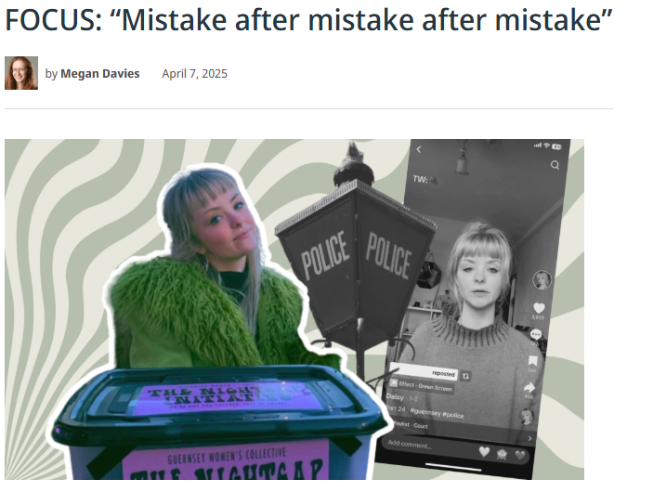
BAILWICK EXPRESS ARTICLE, RAPE SURVIVOR SPEAKS OUT
Sadly, these experiences are not isolated. A lawyer’s eight-page complaint about Ms. A’s case exposed recurring, systemic policing failures: poorly crafted statements, ignored communications, delayed/poor investigations and a lack of victim care, to name a few. Ms A’s lawyer made a point of saying: “A witness statement is only as good as the officer taking it. Unfortunately, all too often with Guernsey police, the officers concerned are not good enough.” The author concluded:
In my opinion, the failures detailed in this letter contradict the public claims that the Guernsey police treat all allegations of domestic abuse seriously and investigate them thoroughly and sensitively… victims of domestic abuse are left feeling unheard, let down and would be reluctant to engage with police in the future should the need arise.
These issues lie not in legislation but in preparation. Home Affairs’ recent amendments feel like stopgap measures, a public relations exercise, attempts to paper over a far a deeper need: training that equips officers to handle violence against women and girls (VAWG) appropriately. Without it, victims face blame, dismissal, and are quite often placed in danger. With a “not fit for purpose” police complaints system and with no decent victim care in place, victims have nowhere to go. No one to turn to.
Police leadership only compounds these problems by dismissing the repetitive failures identified in associated complaints as “management action” or “learning outcomes,” proving they never learn. This was actually admitted, internally, by middle-ranking officers in 2022. One of whom wrote: “There are consistent, repetitive examples of us getting this wrong as an organisation and yet the root cause is not being addressed.”
As someone who tries to help victims, I carry the weight of their stories. One neurodivergent young woman, a rape survivor, burst into tears after sharing her experience. “You’re the only one who’s listened to me,” she said, through a torrent of tears. I kept it it together and then rushed home, locked myself away, and wept—her words lingering, a reminder of the system’s failure to help the vulnerable.
In 2023, while enjoying the sun and drinks in the Slaughterhouse’s pokey courtyard, my phone rang. A parent calling me in despair. Police mishandling of their vulnerable child’s case had left both parent and child with PTSD diagnoses. “Rob,” said the caller, crying. “Never before have I wanted to end my own life. But reading through what the police did to my X, well, I don’t want to live anymore.” I spent an hour talking the caller down, their pain a harsh reminder of reality: Guernsey’s victims and their families need far better support.
“Laws don’t mean anything”, Ms. B recently wrote, “when [Guernsey] police constantly victim blame, accuse victims of being liars, fail to take evidence, actively support and defend abusers, and don’t fully investigate even when the evidence is handed to them.” And she’s right. Without officers trained to investigate VAWG—in fact, all crimes—professionally and sensitively, legislative amendments are meaningless.

MS. B’S SOCIAL MEDIA POST
Often (wrongly) attributed to Mahatma Gandhi: “The true measure of any society is how it treats its most vulnerable.” By that standard, Guernsey falls short—not for its laws, for we are already over legislated, but rather for a system that fails to train law enforcement to protect those who need it most. Until we prioritise equipping officers with the skills to listen and investigate, with empathy and accuracy, no amount of laws will bring justice to survivors or make anyone feel safer.