
Well, it depends. It depends on which one of the several explanations offered by Home Affairs, on differing dates, you accept. And whether you are happy to accept the committee’s claims—without any evidence backing them.
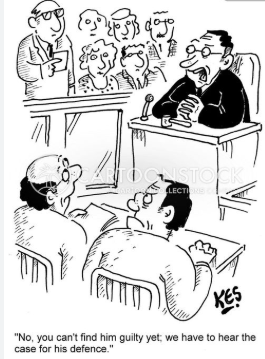
Seven days after Home Affairs claimed that I had breached the terms of engagement of the Group, and despite various requests for supporting evidence, the Committee has been unwilling or unable to provide any evidence. As a result, it is impossible to know what evidence Home Affairs relied upon, if it relied upon any evidence at all, to vote a member of an oversight group off (without notifying members of the group).
The email informing me of my removal, and setting out the reasons for the decision, is publicly available. Notably, it makes no reference to a breach of the “very clear” terms of engagement, as was later claimed by the President of Home Affairs, Deputy Leadbeater. Nor does it allege that I commented on a live case. In fact, the only example cited by the Committee was acknowledged by the Committee to have been formally discontinued. There is also no mention of me discussing a live police complaint matter, as was subsequently suggested.
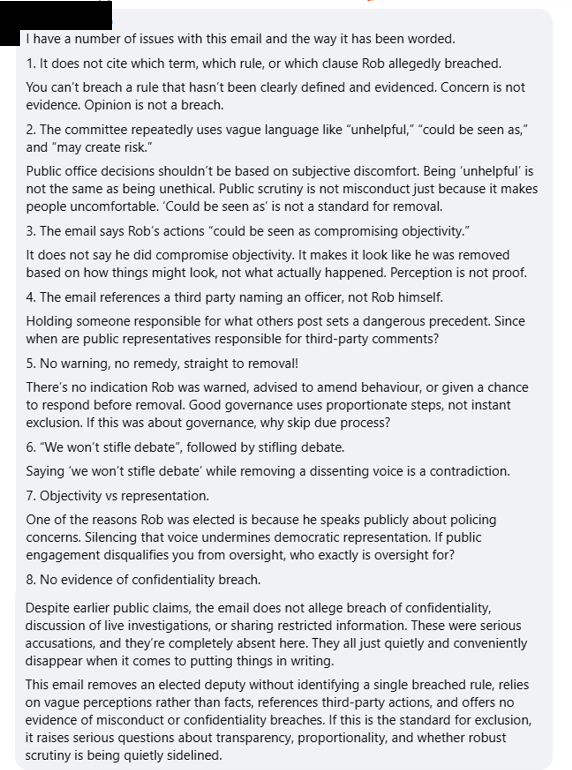
The nub of the argument, then, is this: members of the public were left with the impression Home Affairs had informed me of these alleged breaches and that the committee had provided me with evidence of these alleged breached. This is not a matter of semantics. This impression, if formed, is incorrect and misleading. As one reader summed up:
Following a social media post about the email removing me from the group, and new and previously unheard of claims subsequently made by Deputy Leadbeater in response, I received an email from him at around 1pm the next day: “FYI, one of the live cases you have commented on is the St Pier current case.”
This raises a number of questions. Why had Home Affairs not identified this alleged breach earlier? Why was there no reference to this, or in fact to any live case, in the original rationale removing me from the group? And why did the stated justification for my removal appear to have changed once again?
I was now being told that I had commented on multiple live cases. Meanwhile, the public had been told I had commented on a live criminal case or cases, a live police matter or matters, and a mixture of the two or something else entirely—and it was implied that I had been informed of each and every one of these constantly evolving allegations from the get-go.
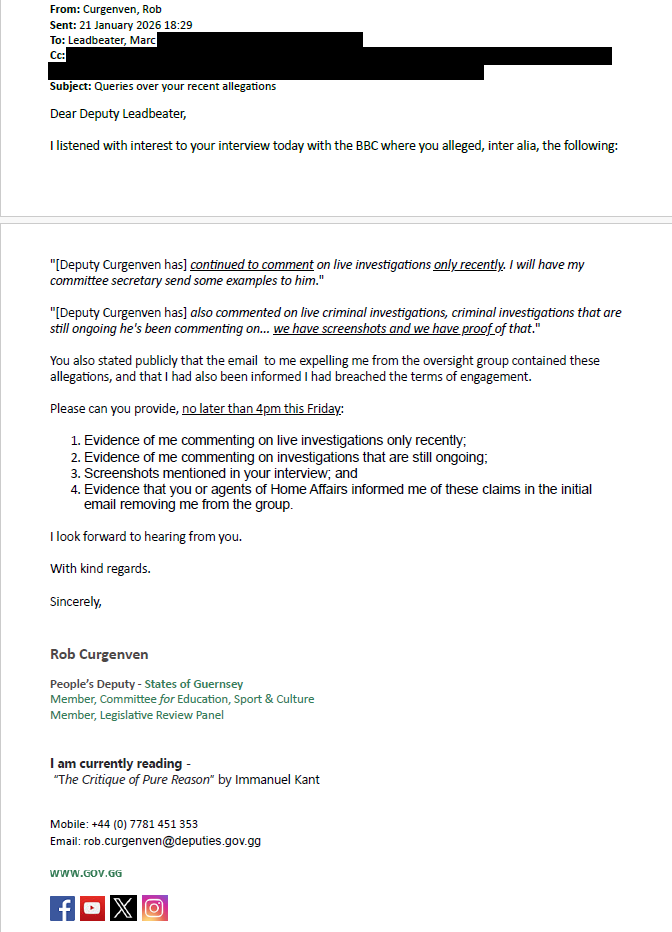
The next day, on 20 January, Leadbeater told the BBC I had “continued to comment on a live investigation only recently,” adding, “we have screenshots and we have proof of that.” He went on to say, “I will have my committee secretary send some examples to him.” To date, despite multiple requests from me, and queries from my peers, no screenshots, no evidence, and no supporting material have been provided.
While I wait for Home Affairs to respond, I went back over my social media feed looking for any mention of “St Pier.” The only relevant reference I could find was in a reel posted on 3 January, where I said:
… since the code of conduct can be so easily weaponised we don’t know who will be in the crosshairs next. We’re not even talking civilly here—which is obviously code of conduct—we’re talking criminally here. I mean, look at what’s happening to Deputy St Pier and his wife for making statements that were already in the public domain.
Which leads me to a further point. Deputy Leadbeater claimed that no member of the group, other than me, had breached the terms of engagement by commenting on a live criminal case.
But this doesn’t appear to be true.
When speaking about Deputy St Pier in the reel, the wording I used was copied near verbatim from a published article either in the Guernsey Press or the Bailiwick Express. I was, in effect, simply parroting what had already been reported. Then it dawned on me: Deputy St Pier had commented extensively on a live criminal investigation, contrary to Leadbeater’s claim.
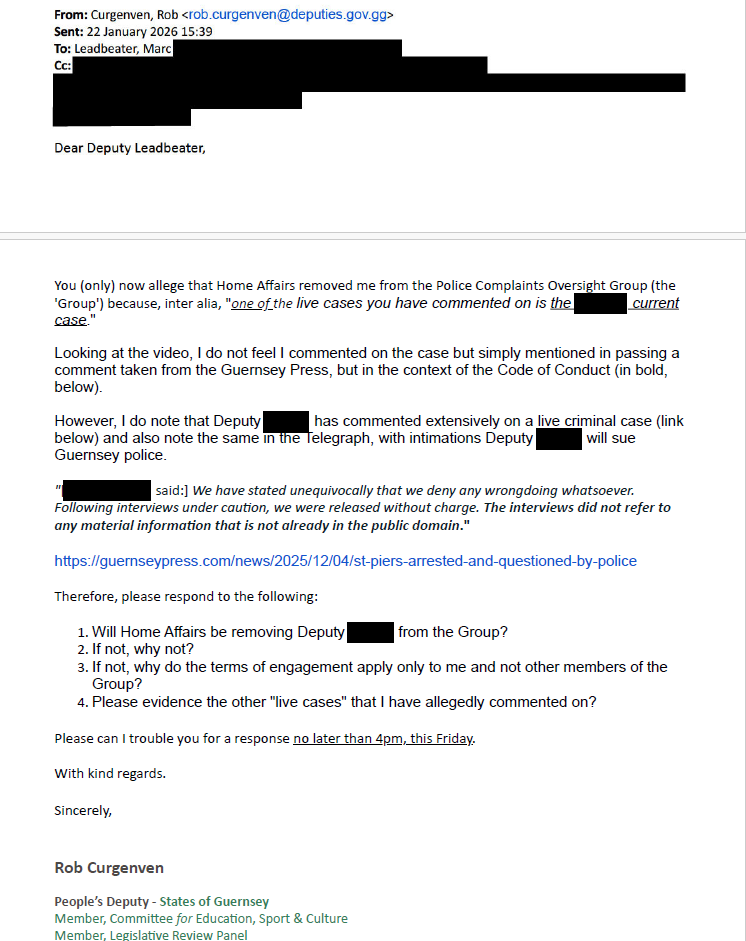
This raises questions as to how the terms of engagement were being interpreted and applied, and whether they were applied consistently, to all members. So, on 22 January, I put this to Home Affairs in an email. In addition, on 26 January, I emailed each Member of Home Affairs individually (again) asking for the evidence.
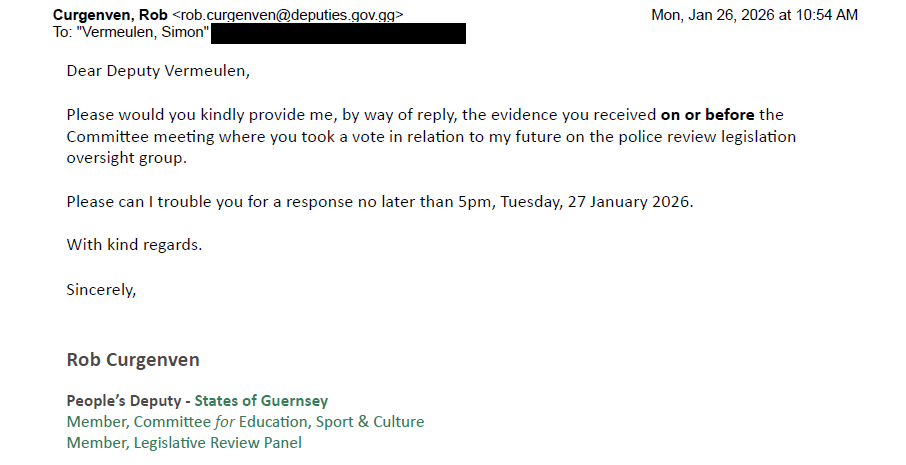
To date, I have had no replies. Nor has the committee secretary provided the “screenshots” or “proof” that Deputy Leadbeater said would be sent. That is to say, Home Affairs refuses to evidence its publicly made claims; refuses to explain the processes followed; and refuses to explain why rules apply to some members, but not to others.
Which segues nicely into the subject of natural justice.
Natural justice ensures that government and committee decisions are transparent, unbiased, and fair to the member in question. Proper notice should be given, as should an opportunity to defend oneself and an adequate timeline to do so. The decision should also be made by someone impartial, which if you read or listen to Leadbeater’s comments—which have been described as nothing more than personal attacks—he appears to some incapable of being impartial.
Adherence to rules of natural justice, as recognised by all civilised governments, is of supreme importance—especially when a committee or quasi-committee embark on determining disputes between the parties or any administrative (or disciplinary action) in question. These rules are intended to prevent authorities from doing injustice.
In the absence of any formal process by which I could respond, represent myself, or challenge these claims, I chose to set out the facts as they stand by way of an article. I do so because clarity and transparency matter—particularly where public confidence and due process are concerned.
Although Deputy Leadbeater point blank refuses to invite me back or even meet to discuss these issues, I offer my services still. I have extensive knowlege of the legislation under review: so why waste it? Elected members must put personal greviances aside to work together for the betterment of the community.
Whichever way you are leaning, questions need answering and the (alleged) evidence available on or before the decision was made must be provided. Otherwise, how anyone fairly trust what Deputies or committees say is fact? At a time when public trust in goverment is at an all time low, this committee’s actions only serves to bolster mistrust.