
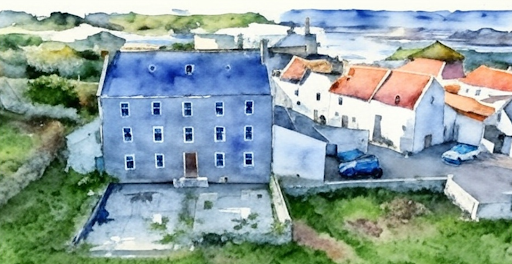
How Guernsey’s planning system fails owners willing to restore derelict buildings.
In this article I examine one recent case, but the issues identified could apply to almost all listed buildings in Guernsey.
The Planning Tribunal’s dismissal of an appeal concerning Les Vardes Farm exposes fundamental flaws in Guernsey’s approach to heritage protection. The system imposes burdens without offering benefits, creates bureaucracy without providing support, and pursues preservation in ways that actively discourage restoration.
Peter and Amy Stenner purchased the derelict property for £1.7m in August 2023, several months after planners hastily listed it in February. Their ambitions were substantial: restore the main house as their family home, convert outbuildings into local market housing, and establish holiday lets. The island stood to gain new homes, tourism revenue, and a restored historic complex.
Instead, they have been forced to abandon most of their plans following a planning dispute that reveals systemic failures across the board.
A System That Punishes Good Intentions
The couple’s difficulties began with what appeared to be a straightforward application to convert a courtyard building into temporary accommodation whilst restoration work proceeded. After five months’ deliberation, planners refused permission on the grounds that the proposal would damage the building’s historic gable parapets.
The Stenners appealed. They lost. However, the tribunal’s decision, published in July, delivered a withering assessment of the Development & Planning Authority that exposed deeper problems.
Regarding the Planning Authority, the tribunal observed: “We believe that the lack of engagement by conservation officers with the Appellants’ team at this early stage, preferably on site, is regrettable and has been a contributory factor in the submission of a planning application which was later determined to be unsatisfactory.”
The tribunal found that officers “missed an important opportunity to advise the Appellants about these additional information requirements at an early stage” and concluded that “if the Authority is unable to follow its own published advice then the advice should be withdrawn, as it otherwise creates false expectations on the part of applicants.”
As for the applicants, the tribunal noted that their professional team lacked heritage expertise and failed to provide essential documentation such as survey drawings or heritage impact assessments.
The Real Problem: All Stick, No Carrot
The Stenners articulated their frustration: “Unfortunately, and despite early and repeated requests for pre-application meetings and advice in order to ensure progress is made in a positive, collaborative and timely way, we are sorry to say that the DPA has largely responded with indifference.”
They found themselves held to “an apparent ‘gold standard’: one that pays little regard to practical and financial reality, the level of information routinely accepted by the DPA in relation to other protected buildings.”
The Consequences
The unsuccessful appeal has compelled the couple to abandon their conversion plans. “The island will lose out on at least one new local market home,” they stated. “We had also hoped to convert the ‘long barn’ to create three more new homes, but no longer have any confidence that this would be achievable.”
They are now concentrating exclusively on the main house, their intended family home. As for the outbuildings: “It is impossible to say whether we will have the energy or enthusiasm to revisit our original plans for the outbuildings in years to come. Inevitably, this means that they will continue to deteriorate at an increasingly rapid rate: something that will only be avoided if the DPA has a change of heart and mind and decides to work with us positively and pragmatically.”
The Stenners invested £1.7m and considerable effort into rescuing these buildings: “We went ahead despite the buildings being in an extreme state of dilapidation and having been protected by the DPA at the eleventh hour, factors that would put off most prospective purchasers. It’s a fact that there were no other interested parties queuing up behind us.” Their reward appears to have been bureaucratic misery.
A Broken Model
Whether or not the Stenners would have sought grant assistance is immaterial; none exists to seek. Their experience with other aspects illustrates a broader problem: the system creates obstacles without offering any of the support mechanisms that exist in other jurisdictions.
Listing buildings imposes substantial additional burdens: specialist consultants, complex applications, elevated costs, and heightened risks of refusal; yet the States of Guernsey offers absolutely no financial assistance.
Other jurisdictions recognise that heritage protection serves the public interest and should not fall entirely upon private owners. They provide grants, tax relief, or planning advantages to redress the balance.
Guernsey adopts the reverse approach; it privatises costs whilst socialising benefits. Private owners shoulder the entire financial burden and navigate all regulatory complexity, whilst the public enjoys preserved buildings and cultural heritage without contributing a penny.
The model’s failure is evident. Willing restorers face discouragement, buildings continue deteriorating, housing remains uncreated, and the planning system becomes (or perhaps remains) adversarial rather than collaborative.
International Comparisons Expose Guernsey’s Isolation
Guernsey’s approach appears particularly indefensible when compared with other jurisdictions. Virtually every developed nation recognises that heritage protection serves the public good and provides meaningful support to offset regulatory burdens.
The United Kingdom offers extensive grant systems. England provides Historic England’s “Repair Grants for Heritage at Risk” for listed buildings, alongside a £20 million Heritage Revival Fund and a £15 million Heritage at Risk Capital Fund targeting deprived areas. Scotland operates multiple grant schemes through Historic Environment Scotland, whilst Northern Ireland offers up to £8,000 per property (£15,000 for thatched buildings) through its Historic Environment Fund.
European countries demonstrate even greater generosity. France leads with state grants covering up to 40% of costs for Monument Historique buildings, supplemented by the Fondation du Patrimoine providing tax relief up to 50% of expenses. Germany offers KfW subsidies and specialised funding programmes for historic properties. Italy provides capital grants and interest subsidies reaching 6% of loan costs. Even Cyprus, a relatively small nation, offers comprehensive support including grants, loans, tax incentives, and innovative transferable development rights.
Jersey, despite its comparable size, recognises the necessity for heritage support. The Jersey Community Foundation Heritage Fund provides grants up to £50,000 annually for heritage projects, explicitly including private owners, funded through Channel Islands Lottery proceeds.
Guernsey stands virtually alone amongst developed jurisdictions in offering listed building owners nothing whatsoever. Whilst other territories treat heritage protection as a shared responsibility requiring public support, Guernsey imposes all regulatory burdens whilst providing zero financial assistance.
The Framework Exists; The Support Does Not
The situation becomes particularly damning upon discovering that Guernsey possesses statutory provision for heritage grants. The Land Planning and Development (Guernsey) Law 2005 incorporates “Schemes, grants and loans” within its framework (section 36); however, Page 50 of the 2024 ARC4 report commissioned by the States confirms these grants have “never been put into effect.”.
More troublingly, reports suggest the State would rather de-list a property than provide grants. This reveals the system’s true priorities: heritage protection remains valuable only whilst it costs the public purse nothing. When confronted with the choice between supporting preservation or abandoning it, Guernsey chooses abandonment.
This represents no accidental oversight; it constitutes a systematic policy choice. The legislation provides the legal machinery both to impose heritage restrictions and to offer financial support, with the clear expectation that the latter will balance the former. The fact that one power sees active use whilst the other lies dormant exposes perverse incentives: control without responsibility, burdens without benefits.
Whilst officers diligently serve compliance notices, enforcement actions, and commence criminal prosecutions against heritage property owners, the same legal framework’s grant provisions gather dust. When owners require grant support, the system’s response appears to be consideration of removing protection rather than providing assistance. This renders the claimed public interest in heritage preservation farcical.
Every other developed jurisdiction that imposes heritage protection provides corresponding financial assistance. Guernsey possesses the legal power to do likewise but chooses not to exercise it, ostensibly preferring to de-list buildings rather than fulfil its statutory responsibilities. This renders the situation for such property owners not merely unfortunate but inexcusable; it results directly from policy choices, not legal limitations.
The Need for Reform
Accordingly it would be difficult not to argue that Guernsey’s heritage protection requires fundamental reform. The legal framework for grants and support already exists; implementation requires only political will. Either activate the dormant statutory grant powers, provide tax relief, and fast-track planning for appropriate schemes, or accept that the current system actively undermines the preservation it purports to promote and cancel it.
At minimum, TRP should be removed from listed buildings. This tax, based on gross floor area, ignores the inefficient space utilisation and elevated running costs: energy bills, repairs, and maintenance that heritage buildings inevitably entail. It disregards the substantial additional expenses repairing and maintaining these properties imposes: specialist architectural fees, conservation-approved contractors charging premium rates, protracted planning processes, and the considerable time and administrative burden of navigating heritage bureaucracy. Moreover, rented listed buildings often suffer extended void periods without tenants; for those containing commercial office space, this tax may reach tens of thousands of pounds annually. The effect on such properties can be devastating.
The alternative means more derelict buildings remaining derelict because Frossard House’s regulatory burden renders restoration uneconomic, and more willing investors abandoning future projects.
One need only to wander through St Peter Port’s town centre to witness this reality. Look upward: empty flats and buildings abound. Mill Street exemplifies devastating neglect. Housing for hundreds sits vacant, often as a direct consequence of these policies.
What Guernsey has created is heritage blight: properties ensnared in regulatory restrictions that prevent development whilst providing no support for preservation, ensuring decay rather than restoration. That outcome serves nobody’s interests.
Sources:
- Planning Tribunal Decision: https://www.gov.gg/CHttpHandler.ashx?id=191853&p=0
- Guernsey Press Coverage: https://guernseypress.com/news/2025/08/03/planners-accused-of-blocking-les-vardes-farm-restoration
- Guernsey Planning Law (including unused grant provisions, section 36): https://www.guernseylegalresources.gg/CHttpHandler.ashx?documentid=54448
- ARC4 Report: https://www.gov.gg/CHttpHandler.ashx?id=185754&p=0
- Historic England Grants: https://historicengland.org.uk/advice/grants/our-grant-schemes/repair-grants/
- Jersey Community Foundation Heritage Fund: https://www.jerseycommunityfoundation.org/our-funds/heritage-fund
- France Heritage Funding: https://www.fondation-patrimoine.org/c/decouvrir-la-fondation/qui-sommes-nous/about-us/1024
- Germany Historic Properties Program: https://www.realportico.com/blog/germany-special-funding-program-historic-properties
- European Heritage Funding: https://culture.ec.europa.eu/cultural-heritage/funding-opportunities-for-cultural-heritage