
In simple words:
Guernsey has a fairness problem with cars. Drivers of petrol and diesel cars pay tax every time they buy fuel, which helps the government pay for roads and services. But people with electric cars pay nothing for the miles they drive. As more electric cars appear on the island’s roads (there are already about 2,000), this gap feels more and more unfair. The simple solution is a new per-mile charge just for electric cars and plug-in hybrids. Owners read their car’s mileage once a year and pay a small amount based on how heavy the car is – for example, around £165 a year for a small electric car or £240–£390 for bigger ones. This is roughly half what a similar petrol car pays in fuel tax, so electric cars still get some advantage. There is no GPS tracking, just an honest yearly declaration, with random checks and mileage records when cars are sold to stop cheating. Guernsey is a small, busy island where everyone uses the roads, so this plan makes sure all drivers contribute fairly without complicated systems. The government agreed to do something like this back in 2019. It’s time to make it happen.
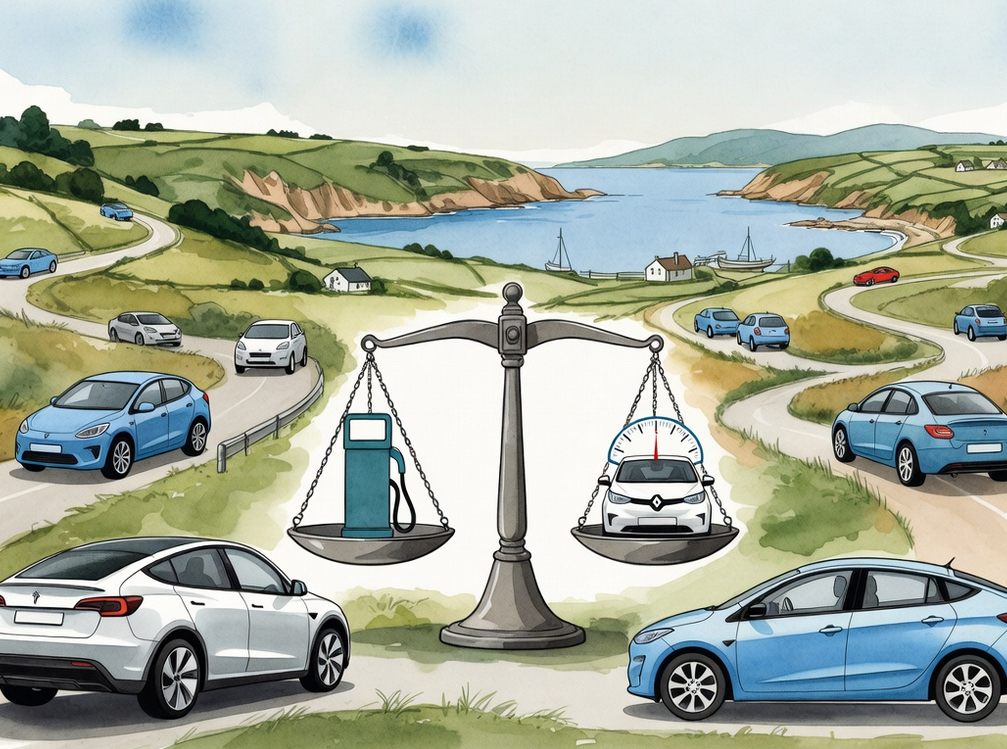
Guernsey faces a problem of ‘fiscal fairness’ that is emotive out of proportion to its size. Every owner of a petrol or diesel car pays into General Revenue on every mile driven, through duty on the fuel they buy. Every owner of an electric vehicle pays nothing on the same basis. As the electric vehicle share of the fleet grows, that gap hardens, borne by a shrinking population of internal-combustion drivers already feeling the pressure of repeated above-inflation fuel-duty rises. Closing the gap costs the States almost nothing and removes a source of resentment that will only grow with each new electric vehicle on the island. This is the case for acting now.
The fiscal context
The scale is modest. Fuel duty raises about £22.5 million a year, while the States operate a structural deficit of roughly £56 million [1]. By October 2025 there were about 2,000 electric cars registered on the island [2], and the share of new registrations that are electric has grown from a handful five years ago to around 11 per cent today. Each new electric vehicle removes a stream of fuel duty without replacing it.
It is worth being honest about what fuel duty actually is. Guernsey does not ring-fence its motoring taxes; fuel duty has paid into General Revenue alongside everything else since the annual road tax was abolished in 2008, and is spent on public services as the Assembly directs. Annual road maintenance, through the Traffic and Highway Services budget [3], is in the order of a few million pounds, a fraction of fuel-duty receipts. The honest framing is therefore not “electric vehicle drivers do not pay for the roads”, because internal-combustion drivers do not pay for the roads either; they pay general taxation that the States happens to levy at the pump. The relevant unfairness is the difference in variable contribution to General Revenue, not the source of road-maintenance funding.
The States already accepted this analysis in principle. In July 2019 it agreed to develop a distance-based charging scheme to replace fuel duty over time [4]. Six years later, the work has not concluded. The Committee for Environment and Infrastructure has been pressing Policy and Resources to bring forward proposals without further delay.
The proposal
The scheme applies in its first phase only to electric vehicles and plug-in hybrids, on the principle that it brings into a per-mile system only those vehicles that do not currently contribute fuel duty. Each keeper pays an annual amount calculated as:
annual charge = pence-per-mile rate × annual mileage
The rate is banded by kerb weight, which is recorded on the registration certificate. Plug-in hybrids pay half the rate applicable to their band, recognising that they still pay fuel duty on the petrol they burn. Conventional hybrids are not in scope.
The indicative rates and worked examples:
| Vehicle | Annual mileage | Rate per mile | Annual charge | Equivalent ICE car fuel duty* |
| Small EV (Renault Zoe, Fiat 500e) | 5,500 | 3p | £165 | £415 |
| Mid-weight EV (Tesla Model 3, VW ID.3) | 6,000 | 4p | £240 | £540 |
| Larger EV (Tesla Model Y, BMW i4) | 6,500 | 5p | £325 | £585 |
| Heavy electric SUV | 6,500 | 6p | £390 | £585 |
| Plug-in hybrid (mid-weight) | 6,000 | 2p | £120 | £540 |
*Fuel duty payable by an equivalent petrol vehicle at 90.5p per litre and assumed fuel efficiency typical for the segment (40 mpg for smaller cars falling to 28 mpg for heavy SUVs). The rates set the electric charge at roughly half the fuel-duty equivalent of a comparable petrol car, preserving a residual incentive in favour of zero-emission propulsion.
Annual mileage is read from the odometer. The keeper submits the figure to Driver and Vehicle Licensing once a year, online or by paper return. There is no GPS, no fitted device, no journey log, and no location data.
Verification operates on two tracks. The first is a random inspection lottery: each year a fixed percentage of keepers is selected at random from the vehicle register and asked to attend a States inspection facility for a two-minute odometer reading, within a 28-day window of their choosing. Vehicles whose mileage has been independently recorded at transfer of keepership or other inspection within the previous twelve months are excluded from the lottery pool, concentrating capacity on vehicles without a recent verified reading.
The second track is the transfer reading. Mileage captured by DVL at every change of keeper feeds into the system as a verified record on the vehicle’s file. Each sale provides an independent reading against which a keeper’s cumulative annual declarations can be checked, with a material discrepancy triggering reassessment. The deterrent effect is significant, because a keeper who has consistently understated mileage cannot avoid the gap showing up when the car is sold, at which point the buyer will see the true reading on the dashboard.
Deliberate odometer fraud would attract substantial civil penalties under existing road traffic legislation; honest error, identified and corrected, would not.
Why a per-mile charge fits a small, dense island
Guernsey has approximately 90,000 registered vehicles serving a resident population of around 64,000, on roughly 115 miles of carriageway across 25 square miles. The vehicle-to-resident ratio is close to 1.4, materially higher than the United Kingdom average and among the highest in Western Europe. Peak-hour congestion, parking pressure in Town, and emissions at major junctions are consequences of traffic density, not of any particular vehicle’s weight or technology.
A per-mile charge measures road use directly rather than the fuel burned to produce it. It is not a true congestion charge: it does not vary by time of day, route, or location, and a mile driven through Town at the morning peak pays the same as a mile driven along a country lane at midnight. The simplification is tolerable on a small island, where on a small island where congestion effects are widely shared across the network, but it should be recognised as a simplification.
Fuel duty has done a similar job for decades by a rougher proxy still, because litres burned correlated with miles driven. As the fleet electrifies, the proxy breaks: a growing share of road users imposes the same density costs as everyone else but pays none of the variable charge that funded the consequences. The proposed scheme replaces a deteriorating proxy with a better one, with a modest weight component reflecting the larger road and parking footprint of heavier vehicles.
If the States wished to price congestion directly, the appropriate instrument would be either a cordon or time-of-day scheme on the approaches to Town, of the kind used in London and elsewhere, or a GPS-based system using density mapping to charge variable rates by location and time. Both are larger policy steps, and the GPS option re-opens the privacy debate that this proposal is designed to side-step. Both properly belong in the broader replacement of fuel duty contemplated by the 2019 resolution. This proposal is the first step in that direction, not the destination.
What about goods vehicles?
The scheme excludes commercial vehicles, vans, and motorcycles in its first phase, following the precedent of the United Kingdom electric vehicle excise duty regime [5]. The Guernsey commercial fleet remains overwhelmingly diesel and continues to pay fuel duty in the ordinary way; the fairness gap addressed here does not arise. Commercial vehicles will need their own framework as the haulage fleet electrifies, drawing on the telematics and fuel-card data those operators already keep, but that is a separate piece of policy work.
A point on road damage is worth being honest about. Road wear scales with axle load to roughly the fourth power. A fully laden 7.5-tonne lorry does of the order of a thousand times the damage of a 1.8-tonne electric car on a single pass; a 26-tonne lorry several thousand times more. The great majority of road damage in Guernsey is caused by commercial vehicles, not cars. The weight banding in this proposal is therefore a fairness device, not a true proportional charge for damage.
What it would raise
On the current fleet the scheme generates gross revenue of approximately £640,000 a year. The single-year figure is small set against either General Revenue or the structural deficit, and the article makes no pretence that it solves the public finance problem. The argument is fairness, not fiscal repair. But the trajectory matters: fuel duty receipts are now in structural decline, and the scheme is an asset whose value grows as the underlying problem worsens.
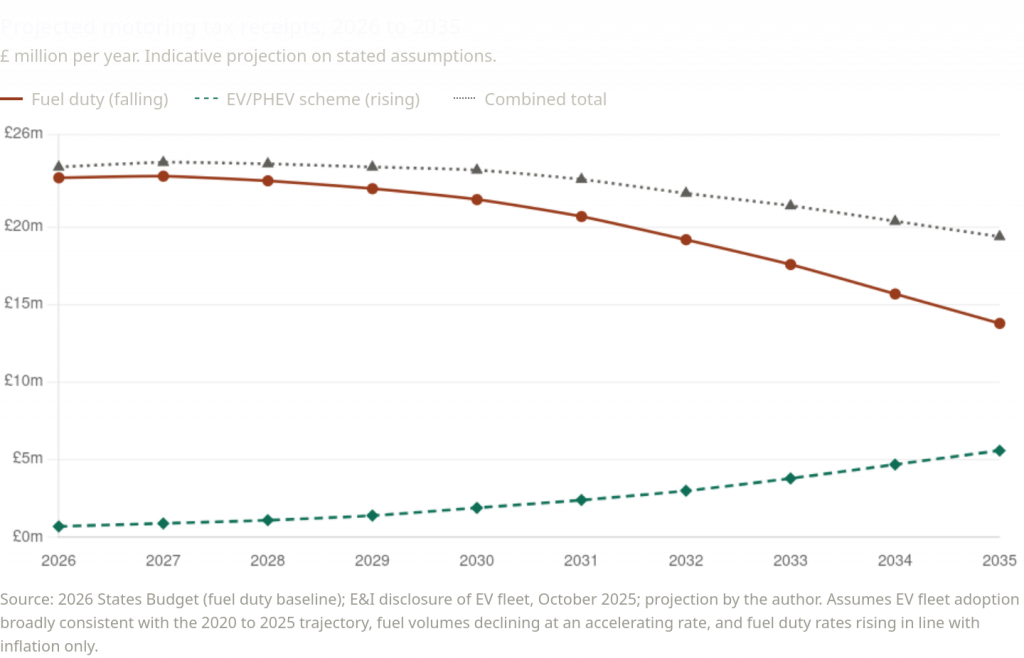
On the assumptions used, fuel duty receipts fall from £23.2 million in 2026 to £13.8 million in 2035. The proposed scheme grows from £0.7 million to £5.6 million across the same period. Combined receipts fall from £23.9 million to £19.4 million; without the scheme, the fall is to £13.8 million. Over the decade, the scheme preserves the order of £25 million of cumulative revenue that would otherwise be lost.
Delivery
The system is administratively modest. The functional requirements are well-defined: an annual declaration channel, a banded rate calculator, a workflow for civil compliance, a random selection mechanism over the live vehicle register, and integration with the existing DVL change-of-keeper process. None of this is technically demanding.
The right approach is a small, standalone application with its own authentication and payment gateway, drawing a read-only feed from the existing Driver and Vehicle Licensing register for kerb weight and keepership data. The deliberate avoidance of deep integration with the wider States IT estate reflects the lessons of the MyGov programme [6], which the April 2026 investigation report found had cost £21.6 million for £1.3 million of demonstrable savings. The prudent path is small, single-purpose, structurally separable systems that can be delivered in months rather than years.
A realistic build cost on outcome-based terms is £250,000 to £600,000 as a one-off, with annual operating costs of £100,000 to £250,000. On the current fleet alone the scheme pays back its build cost within 12 to 24 months, and the ratios improve as the fleet grows.
Why now
The States agreed to the principle in 2019. Each year of delay compounds costs. The fairness gap widens as more electric vehicles join the fleet and contribute nothing on a per-mile basis. The political difficulty of closing the gap rises as the number of stakeholders in the current exemption grows.
The scheme proposed here is not transformative, and is not presented as such. It is administrative, proportionate, technically straightforward, and consistent with a policy decision the States has already taken. The proposal is intentionally limited to vehicles that currently fall outside the fuel-duty system, and does not create a GPS road-pricing framework.
There is no technical reason for further delay, and no obvious political reason that the work has not been completed.
Sources
[1] States of Guernsey, Budget 2026 (Policy Letter), published October 2025; debated and approved 5 November 2025. https://www.gov.gg/CHttpHandler.ashx?id=194596&p=0. Budget index: https://www.gov.gg/budget.
[2] Bailiwick Express, Tax and charging points on the cards as EV registrations soar, 24 October 2025, reporting Deputy Adrian Gabriel’s response to parliamentary questions from Deputy Jayne Ozanne: 2,844 electric vehicles registered, of which 1,954 cars. https://www.bailiwickexpress.com/news-ge/tax-and-charging-points-on-the-cards-as-ev-registrations-soar/.
[3] States of Guernsey, Road maintenance, Traffic and Highway Services guidance describing the work programme and the scope of the public highway. https://gov.gg/roads.
[4] States of Guernsey, Taxation of Motoring, recording the July 2019 States agreement to develop a distance-based charging scheme, with the intention that a similar total level of revenue would be raised as under the current excise duty on motor fuel. https://www.gov.gg/taxationofmotoring.
[5] UK Parliament, House of Commons Library, Electric vehicle excise duty (eVED), briefing setting out the United Kingdom’s planned mileage-based charge for electric vehicles and plug-in hybrids. https://commonslibrary.parliament.uk/research-briefings/cbp-10607/.
[6] States of Guernsey, MyGov investigation report published, news release 21 April 2026, reporting £21.6 million spent on the MyGov programme for £1.3 million of demonstrable savings; Agilisys contract terminated July 2025. https://www.gov.gg/MyGov-investigation-news.