
The States of Guernsey recently told us the MoneyVal inspection was “highly successful” (link). But is this really an accurate reflection of the findings?
Imagine a doctor tells you there’s a 75% chance of dying. Now imagine being told you have a one in four chance of survival. Both present the same facts, yet your emotional response likely differs based on how the information is framed.
What if the doctor adds, “Others in your situation have benefited from highly successful treatment”? You still face a three-in-four chance of dying, but her phrasing might leave you feeling more optimistic—even though it’s vague and fuzzy.
Let’s assume the doctor believes patients do better when they stay positive. Her agenda is clear: the doctor aims to prioritise her patients’ wellbeing. So she frames the facts in a way that emphasises hope (“you have a one in four chance”).
Similarly, the States of Guernsey’s agenda is to protect its image, making MoneyVal findings crucial. With this goal in mind, the States presented the findings as follows
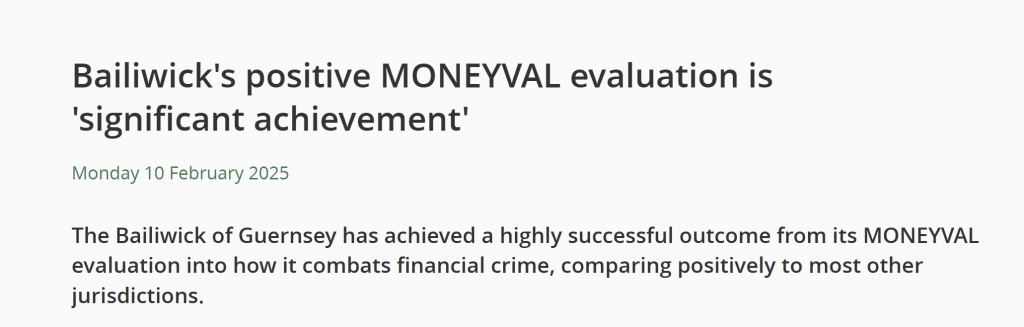
But ITV, a Jersey based entity, put it like this

The States also told you, “The Bailiwick received pass ratings for six out of the 11 categories”. In contrast, ITV wrote “assessors… failed [Guernsey’s] response to financial crime in five out of 11 areas”. In both cases, we see the same facts but framed with different emphases.
On the one hand the States labelled the inspection “highly successful”; but on the other hand, Deputy Rob Prow claimed “we have shown that overall we meet the standards”. So which is it? It can’t be both. While the former implies excellence, the latter indicates adequacy.
Deputy Prow further stated we “compare positively to most other jurisdictions”, leaving readers to ponder the meaning of this. Consider ITV’s take, “Guernsey had six passes and five failures, compared to Jersey which passed seven categories…”. Here, at least, Guernsey doesn’t fare as well against its neighbour, challenging the narrative of a positive comparison.
The truth is, most of us are unlikely to read through the MoneyVal report in full. It’s long, it’s tedious, and you’ve got better things to do. To save time, you may turn to your favourite newspaper or States Comms team for a summary. But remember, whoever you rely on has their own agenda. Usually they want you to believe “their” side of the story. And to get you onboard, they have an infinite number of tricks to employ without resorting to lying.
For example, I could spend a lot of time hunting through MoneyVal findings for snippets in support of my argument, whilst ignoring parts that don’t. If I was smarter, I could write an article appearing impartial but at the same time subtly manipulate readers into drawing a conclusion I wanted them to reach all along.
Let’s take the Guernsey police’s Communication Officers as a real life case study. What do you think their agenda might be? Here’s an extract from an email sent to police and Home Affairs (from Comms) discussing a public statement prior to its release
“The statement has been approved by Advocate… and is drafted in such a way that maintains professionalism and doesn’t overstep any boundaries, but also acknowledge the good (from a police pov). Really we want to use this as a vehicle to avoid answering any specific qs from the media…”.
This excerpt reveals how Comms teams often craft statements to protect their institution’s image while steering the narrative. So don’t automatically assume everything you read accurately reflects reality. Facts and information can be spun differently to serve different agendas.