
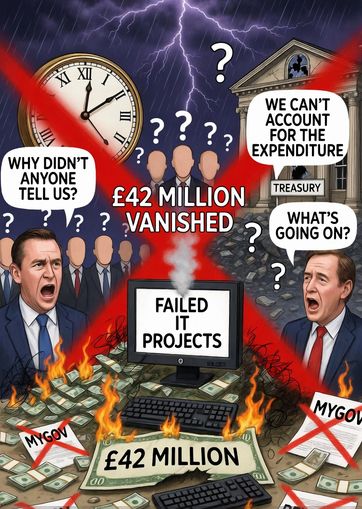
Guernsey squandered £42 million on two IT projects that failed to deliver. Politicians were misled about the true state of the MyGov and Revenue Service programmes, which floundered despite substantial investment. It appears that the Treasury cannot account for where the money went.
Deputy Lindsay de Sausmarez revealed that financial controls existed but were routinely ignored, external suppliers failed to deliver without consequence, concerns were not addressed promptly, and there was a significant gap between what politicians were told and the actual state of progress.
The “significant disparity between how the project’s status was reported and the reality of its progress” suggests willful concealment rather than mere incompetence.
New Chief Executive Boley Smillie is now investigating, with the Internal Audit team (why not external Auditors?) marking their own homework redirected to focus on understanding how these failures occurred and where accountability lies. Deputy Gavin St Pier previously disclosed the £42 million write-off in November 2025.
“Concerns raised about the project were not addressed adequately or in a timely manner… there was a significant disparity between how the project’s status was reported (including to politicians) and the reality of its progress”.
Deputy de Sausmarez
Critical questions:
- Where precisely was the £42 million spent? If Treasury cannot trace the expenditure, either payments were not properly recorded or documentation has vanished.
- Were suppliers paid without delivery?
- Were there proper specifications and requirements documentation for these projects, or did work proceed without clear deliverables?
- Did the management team actually know what they wanted to build, or were they making it up whilst burning through public funds without accountability?
Taxpayers are stakeholders in the States of Guernsey, analogous to shareholders in a company. The inability to account for £42 million suggests potential fraud or gross negligence rather than mere project mismanagement. In the UK, in a private company, directors presiding over such failures would face criminal prosecution under the Fraud Act 2006 (maximum 10 years imprisonment) and immediate removal from office. Disqualification from holding directorships for up to 15 years would be mandatory. No competent board would retain executives who lost £42 million without trace.
Guernsey’s civil service employment ‘framework’ (unions, torpor, protected jobs) may prevent dismissal, but allowing continued involvement guarantees repetition of failure.
The question is whether those responsible in Guernsey’s public sector remain in post, continue to draw salaries, and retain decision-making authority over further expenditure. Or worse – design the replacements to their previous failures.
Surely it would be cheaper to simply pay these people and not allow them anywhere near public administration. Perpetual gardening leave.